ADSP
  • WHO WE ARE
    • History
    • Where we work
    • ADSP Strategy 2023-2025
    • Our team
    • Governing body
  • WHAT WE DO
    • Projects
    • TRAININGS AND WORKSHOPS
    • Research
    • Advocacy
    • Our Impact
    • RESOURCES
      • Global
      • Region
      • Afghanistan
      • Iran
      • Pakistan
      • Policies & Strategies
  • PUBLICATIONS
    • Research Reports
    • Statements
    • Press Releases
    • Briefing Notes
    • Submissions
    • Opinion Articles / media
    • NEWSLETTERS
  • VISUALISATIONS
    • Herat data visualisation
  • TRAININGS
  • CONTACT US

Opinion Articles / media

HomePublicationsOpinion Articles / media

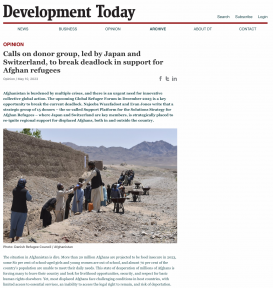
ADSP Op Ed: Calls on donor group, led by Japan and Switzerland, to break deadlock in support for Afghan refugees

May 10, 2023

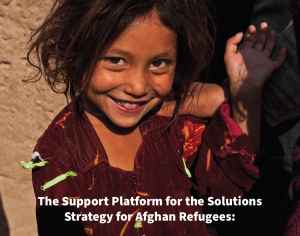
Afghanistan is burdened by multiple crises, and there is an urgent need for innovative collective global action. The upcoming Global Refugee Forum in December 2023 is a key opportunity to break the current deadlock. Najeeba Wazefadost and Evan Jones write that a strategic group of 15 donors – the so-called Support Platform for the Solutions Strategy for Afghan Refugees – where Japan and Switzerland are key members, is strategically placed to re-ignite regional support for displaced Afghans, both in and outside the country.

The situation in Afghanistan is dire. More than 20 million Afghans are projected to be food insecure in 2023, some 80 per cent of school-aged girls and young women are out of school, and almost 70 per cent of the country’s population are unable to meet their daily needs. This state of desperation of millions of Afghans is forcing many to leave their country and look for livelihood opportunities, security, and respect for basic human rights elsewhere. Yet, most displaced Afghans face challenging conditions in host countries, with limited access to essential services, an inability to access the legal right to remain, and risk of deportation.

While the challenges are immense, there exist two avenues through which real progress can be made. One is the upcoming Global Refugee Forum, to be hosted by the UN refugee agency UNCHR.

The inaugural Global Refugee Forum held back in 2019, brought together 3,000 delegates, including governments, the private sector, academia, civil society, and refugees. It aimed to galvanize political support and to mobilize financial, material, and technical assistance for host countries and refugees globally. The event solidified the notion of comprehensive responses as the solution for refugee displacement. It was broadly successful in building interest, commitments, and pledges to action to improve conditions and protection of refugees. Though most of the pledges on Afghanistan made at the time have remained unfulfilled, the second Global Refugee Forum which takes place in seven months provides a unique opportunity to reinvigorate the search for more long-term support for Afghan refugees.

Beyond pledging, a significant outcome of the forum in 2019 was the establishment of a donor group, the Support Platform for the Solutions Strategy for Afghan Refugees. It was tasked with pursuing increased collaboration on long-term support and solutions for displaced Afghans. Today, the grouping has 15 members, including the World Bank, and the governments of Switzerland, Japan, Qatar, Turkey, the United States, and the European Union. Chaired by the EU, the donor platform has yielded some positive results, including the operationalization of groups on livelihoods and education in Pakistan.

Looking forward to the gathering this December, the Support Platform is the international community’s best-placed body to garner support and make tangible change in the lives of displaced Afghans in neighbouring countries. The grouping has a mandate to collectively identify and work towards priority and long-term needs such as education, health, livelihoods, and resilience programming. These donors are well-positioned to allocate resources for the UN’s Humanitarian Response Plan for Afghanistan and the Regional Refugee Response Plan, and to engage with the NGO community to ensure that responses are coordinated and cohesive.

Furthermore, the Support Platform can address the issue of Afghan displacement from a regional perspective. By working through national channels, support can be mobilised for Afghans across the region through a comprehensive suite of funding, technical support, and engagement. It is important that the donor group addresses the root causes of displacement, expands access to basic services, supports climate action, and creates livelihood opportunities for displaced Afghans and host communities.

We appreciate that donor governments are forced to tread cautiously when it comes to engaging in Afghanistan and some neighbouring countries. Financial sanctions, liquidity challenges and an inability or unwillingness to engage with the Taliban limit the scope, amounts, and types of available funding. Solutions to Afghan displacement are complex, and there are no silver bullets. Nevertheless, we believe that donors within the Support Platform can and should create the space needed to mobilise support for Afghans at home and in neighbouring countries.

For example, the Support Platform could establish a common understanding of the challenges facing the Afghanistan economy and the steps needed to stabilise it by bringing together the UN, private sector, NGOs, community-based organisations, microfinance institutions, UN member states and multilateral development banks. They could foster partnerships across the humanitarian-development-peace nexus to better deliver access to basic services, build resilience and improve community services.

To be more effective, the Platform should be more inclusive of NGO stakeholders and better recognise refugees’ own perspectives. Some of these adjustments are already underway.

In the lead up to the Global Refugee Forum, the Platform could evolve into an even stronger vehicle of change. There is an enormous opportunity for states to come together and make joint pledges to support displaced Afghans. Both short-term humanitarian needs and longer-term development approaches are needed. Targeted support for host countries, which currently host upwards of 6 million Afghan refugees, that allows for better access to education, healthcare and livelihoods could be a gamechanger for displaced Afghans, and for the trajectory of Afghanistan in the long-term. Pledges could also include supporting registration efforts for newly arrived refugees, expanding resettlement pathways, supporting a widening of education services in host countries, and furthering access for refugees to public health services.

With only seven months to go before the Global Refugee Forum meets, member states in the Support Platform should, in consultation with refugee and IDP-led organisations and NGOs, develop innovative and meaningful pledges for action. In particular, Switzerland and Japan, in their respective roles as co-host and co-convener of the Global Refugee Forum 2023, have the unique ability to champion the cause of displaced Afghans.

The Global Refugee Forum is an important milestone for the Support Platform to work towards, as it expands its base of stakeholders, and seeks to deliver a range of tangible initiatives to meet the needs of millions of displaced Afghans, particularly women and girls. Let’s not allow this opportunity to pass us by.

Najeeba Wazefadost is Founder and Executive Director of the Asia Pacific Network of Refugees (APNOR), based in Sydney, Australia 

Evan Jones is Manager of the Asia Displacement Solutions Platform (ADSP), based in Dhaka, Bangladesh

This article was originally published in Development Today.
TagsAfghanistanhost countriesSSARSupport Platform for the SSAR

Related Posts

Newsletters

ADSP Newsletter: Q4, 2025

March 11, 2026
Newsletters

ADSP Newsletter: Q3, 2025

December 12, 2025
Publications

Research Brief: Durable Solutions Analysis in Herat (July 2025)

August 28, 2025
Newsletters

ADSP Newsletter: Q2, 2025

August 18, 2025
Newsletters

ADSP Newsletter: Q1, 2025

May 29, 2025
Publications

ADSP Statement: One million Afghans returned from Pakistan at risk if unsupported

May 23, 2025
Newsletters

ADSP Newsletter: Q4, 2024

January 30, 2025
Opinion Articles / media

Expert Analysis: Water, climate, and refuge across Afghanistan and the sub-region (October 2024)

November 29, 2024
Newsletters

ADSP Newsletter: Q3, 2024

November 19, 2024
Publications

Research Brief: Durable Solutions Analysis, Jalalabad/Nangarhar (August 2024)

September 5, 2024
Newsletters

ADSP Newsletter: Q2, 2024

August 14, 2024
Publications

Research Brief: Land Allocation Schemes for the Displaced in Afghanistan (June 2024)

August 6, 2024
Newsletters

ADSP Newsletter: Q1, 2024

June 7, 2024
Briefing Notes

Briefing Note: Solutions for Afghan nationals ordered to return from Pakistan

May 13, 2024
Newsletters

ADSP Newsletter: Q4, 2023

December 27, 2023
Briefing Notes

ADSP Briefing Note – Afghan Children’s Access to Education in Iran and Pakistan

December 22, 2023
Briefing Notes

ADSP Briefing Note – Forced to migrate: Afghan women waiting for protection in Iran and Pakistan

December 22, 2023
News

ADSP-ICVA Statement – The SSAR Support Platform: ‘Showing Resilience, Seeking Solutions’

December 13, 2023
News

NGO Statement on Protection at UNHCR 74th Executive Committee Meeting

October 14, 2023
Newsletters

ADSP Newsletter: Q3, 2023

October 14, 2023
Briefing Notes

ADSP-ICVA: Explainer to the Support Platform for the Solutions Strategy for Afghan Refugees

September 10, 2023
News

ADSP Newsletter: Q2, 2023

June 24, 2023
Briefing Notes

ADSP Briefing Note: Local Integration? Insights from the field, and from a local NGO working on improving the resilience of displacement affected communities

May 17, 2023
Briefing Notes

ADSP Briefing Note: Local Integration for IDPs in Kandahar? Insights from the field

April 22, 2023
Newsletters

ADSP Newsletter: Q1, 2023

March 31, 2023
Briefing Notes

ADSP Expert Commentary #2: Rethinking Durable Solutions in Peri-Urban Areas in Pakistan

March 26, 2023
Briefing Notes

ADSP Expert Commentary #1: Afghan refugees in Pakistan – Protracted displacement or protracted settlement?

March 20, 2023
TRAININGS AND WORKSHOPS

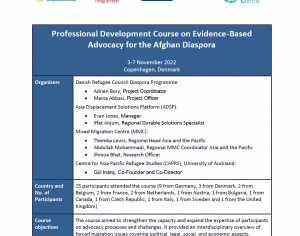
Professional Development Course on Evidence-Based Advocacy for the Afghan Diaspora

January 4, 2023
Briefing Notes

Briefing Note: IDP returns in Afghanistan: are durable solutions possible?

October 17, 2022
Newsletters

ADSP Newsletter: Q3, 2022

October 11, 2022
Newsletters

ADSP Newsletter: Q2, 2022

July 13, 2022
Opinion Articles / media

ADSP Op-Ed: Amid Afghanistan’s Emergency, Its Neighbors Need Support

June 27, 2022
News

ADSP Article: Lessons from drought response in Afghanistan

May 29, 2022
Newsletters

ADSP Newsletter: Q1, 2022

April 18, 2022
News

ADSP Submission: Intersessional Panel Discussion on the human rights of migrants in vulnerable situations

March 8, 2022
News

ADSP Newsletter: Q4, 2021

January 17, 2022
News

ADSP Op-Ed: Afghanistan’s upheaval is no excuse to ignore local aid promises

November 30, 2021
News

UK Foreign Affairs Committee inquiry into the future of UK policy towards Afghanistan following the international military withdrawal: Written evidence submitted by Asia Displacement Solutions Platform (AFG0014)

October 15, 2021
Newsletters

ADSP Q3 Newsletter 2021

October 1, 2021
News

Op-Ed: A plea for Afghanistan

September 20, 2021
News

ADSP Op-Ed: As international troops depart Afghanistan, the threat of landmines remains

August 11, 2021
News

Statement: Rising instability necessitates immediate suspension of deportations to Afghanistan

July 15, 2021
News

ADSP Op-Ed: Troop withdrawals won’t end Afghanistan’s humanitarian crisis

June 19, 2021
News

ADSP Op-Ed: Forced return of Afghans hampers the pursuit of durable solutions

April 22, 2021
Publications

Lessons Learned & Recommendations: Re-Imagining the 2018 Afghanistan Drought Response

January 31, 2021
Publications

Re-Imagining the 2018 Afghanistan Drought Response

January 31, 2021
News

ADSP Op-Ed: Will the Afghanistan Conference deliver for Afghan refugees?

November 24, 2020

Recent Posts

  • ADSP Newsletter: Q4, 2025
  • ADSP Newsletter: Q3, 2025
  • Toward Durable Solutions: Mapping and Analysis of Displacement Data in Asia and the Pacific
  • Research Brief: Durable Solutions Analysis in Herat (July 2025)

Funded by

CONTACT US
[email protected]

© ADSP - Asia Displacement Solutions Platform 2022
  • Privacy Policy & Cookie
This website uses cookies to improve your experience. We'll assume you're ok with this, but you can opt-out if you wish.Accept Read More
Privacy & Cookies Policy

Privacy Overview

This website uses cookies to improve your experience while you navigate through the website. Out of these, the cookies that are categorized as necessary are stored on your browser as they are essential for the working of basic functionalities of the website. We also use third-party cookies that help us analyze and understand how you use this website. These cookies will be stored in your browser only with your consent. You also have the option to opt-out of these cookies. But opting out of some of these cookies may affect your browsing experience.
Necessary
Always Enabled
Necessary cookies are absolutely essential for the website to function properly. This category only includes cookies that ensures basic functionalities and security features of the website. These cookies do not store any personal information.
Non-necessary
Any cookies that may not be particularly necessary for the website to function and is used specifically to collect user personal data via analytics, ads, other embedded contents are termed as non-necessary cookies. It is mandatory to procure user consent prior to running these cookies on your website.
SAVE & ACCEPT