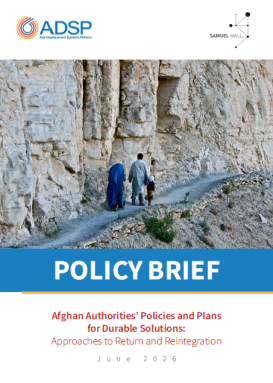
Policy Brief: Afghan Authorities’ Policies and Plans for Durable Solutions: Approaches to Return and Reintegration (June 2026)

This Policy Brief maps Afghan authorities’ current policies, practices, and perceptions related to durable solutions to displacement for the period 2021-2025 and looks forward to priority interventions. It identifies gaps between policy frameworks and community realities, and generates recommendations for ADSP, the Durable Solutions Working Group (DSWG) in Afghanistan, donors and relevant authorities. Based on…
READ MORE

ADSP Briefing Note: Exploring Intra-Regional Complementary Pathways for Refugees in South and Southeast Asia (June 2026)

This briefing note explores the potential of expanding complementary pathways for refugees, focusing in particular on intra-regional options within South and Southeast Asia and qualifications/skills-based pathways. Informed by a detailed desk review and 15 key informant interviews conducted between February and April 2026, this briefing note argues that, with attention to protection needs, intra-regional complementary…

READ MORE

ADSP Briefing Note: Strengthening Whole-of-Society Preparedness for Ongoing Arrivals of Displaced Populations into Thailand and Malaysia (June 2025)

The ongoing crisis in Southern Asia has driven significant cross-border displacement into Thailand and Malaysia, where preparedness measures remain fragmented, with limited space for joint solutions-oriented planning to foster inclusion and resilience. This briefing note calls for the adoption of whole-of-society approaches to strengthen both immediate responses and the enabling environment for long-term solutions for…

READ MORE

A guide for NGOs: Utilising the Bali Process to improve protection of Rohingya communities

Founded in 2002, the Bali Process is designed to ‘facilitate cooperation and collaboration, information-sharing and policy development on irregular migration in the Asia-Pacific region and beyond’. The Bali Process exclusively focuses on issues related to migrant smuggling and trafficking in persons. In relation to Rohingya displacement, it has been considered as an important mechanism when…

READ MORE

A guide for NGOs: Utilising ASEAN to promote solutions for Rohingya communities

Formed in 1967, the Association of Southeast Asian Nations (ASEAN) is the primary intergovernmental institution for promoting integration and cooperation in Southeast Asia. Given the transnational nature, scale and protractedness of Rohingya displacement, many actors have discussed the potential role of ASEAN in addressing related challenges. In this perspective, this guide is intended to support…

READ MORE

Impact of Climate Change on the Migration and Displacement Dynamics of Rohingya Refugees

Research Report & Briefing Paper There is growing recognition that climate change is a factor driving displacement – primarily within borders, but also across international borders (usually within the same region). Climate change is seen as a “threat multiplier,” exacerbating existing inequalities and risks – for example, through destroying shelter or increasing food insecurity. Groups…

READ MORE

Briefing Note on the Mental Health of Refugees and Asylum Seekers in Malaysia: a Detention Focus

The lived experience of forced displacement often implies trauma and can lead to an increased prevalence of mental health conditions and challenges to psychosocial well-being. Long ignored, this fact has recently been acknowledged by the international community and led to new research and interventions. In this context, the mental health repercussions of immigration detention on…

READ MORE

Displacement from Myanmar: How We Got Here and What More Can Be Done

Expert Commentary by Dr Nyi Nyi Kyaw and Caitlin McCaffrie Myanmar has long been the primary source of displacement in Southeast Asia, resulting in refugees and people seeking asylum from Myanmar living across Southeast and South Asia, often in precarious circumstances. This paper aims to unpack the current situation facing those displaced from Myanmar and…

READ MORE

ADSP Briefing Note – Afghan Children’s Access to Education in Iran and Pakistan

The De facto Authorities (DfA) imposed restrictions on women and girls’ education in 2022, banning secondary schooling for girls throughout Afghanistan and suspending tertiary education for women. The decreased access of girls to secondary and tertiary education will not only impact girls and women but the Afghan economy as a whole. Restrictions on female education,…

READ MORE