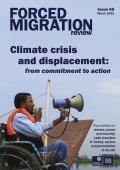
ADSP Article: Lessons from drought response in Afghanistan
This article was originally published in Oxford’s Forced Migration Review, and is available here.
Failure to anticipate drought and to coordinate an effective, recovery-focused response contributed to the protracted displacement of hundreds of thousands of people in Afghanistan. In the face of climate crisis impacts, ensuring preparedness and early action will be key.
In 2018 Afghanistan experienced a severe drought that had a direct impact on more than two-thirds of the country’s population of 38 million. The drought resulted in failed harvests, empty groundwater reserves, and a spike in food insecurity in 22 out of 34 provinces.[1] Subsequently, it led to mass internal displacement with approximately 371,000 Afghans forced to leave their homes and seek refuge in other parts of the country. In Afghanistan’s western region alone, the drought triggered the displacement of more than 170,000 people.[2] Four years later, and in the midst of a second drought, many of these internally displaced persons (IDPs) have still not been able to access ‘durable solutions’, unable to return to their places of origin or to integrate within local communities.
In locations such as Shahrak-e-Sabz, an informal settlement on the outskirts of Herat City, more than 12,000 families remain displaced, with many still in dire need of basic assistance because they cannot access sustainable livelihoods, and therefore are unable to build their resilience.[3] Forced to flee their homes as a result of the drought (and other threats such as conflict and limited access to medical facilities), they have few prospects of being able to return home in the near future. Issues such as access to livelihoods and water, the availability of safe and arable farmland, and insecurity continue to present challenges and result in tens of thousands of IDPs living indefinitely in a state of limbo. In some cases they are turning to negative coping mechanisms including selling personal possessions and even selling their children, usually girls. Herat’s informal settlements are a stark reminder of the need for development and humanitarian stakeholders to work hand-in-hand through all stages of climate- induced displacement if long-term solutions to displacement are to be achieved.
Learning the lessons from climate emergencies in countries like Afghanistan is essential to strengthening responses both in Afghanistan and elsewhere. By 2040, it is estimated that 700 million people worldwide will experience drought for six months or longer, resulting in harsh conditions that will undoubtedly contribute to the forced movement of people – either internally or across national boundaries. Without understanding what has (and has not) worked in different contexts, climate- displaced communities will largely remain unable to access durable solutions.
The need for comprehensive early action
Prior to Afghanistan’s official declaration of drought in April 2018, the country had already been experiencing an 18-month dry spell. However, early warning signals were not communicated in a timely manner by the relevant actors (the Afghanistan National Disaster Management Authority, ANDMA, in particular), despite strong indicators that this dry spell would evolve into a drought. With no clear strategy in place for how to mitigate slow-onset drought conditions, ANDMA’s response failed to catalyse early action either by the government or by other key humanitarian actors.
In contrast, the Famine Early Warning System Network and the NGO iMMAP did produce a series of detailed reports during the initial drought onset period. However, dissemination was limited, and the reports were not translated into Dari or Pashto. As such, the impending drought and the potential humanitarian impacts – including large-scale displacement – were not fully understood across the wider humanitarian community, and hence the need for preparedness measures was not foreseen.[4] This resulted in a failure by decision-makers and humanitarian actors to implement collaborative and cohesive development and resiliency interventions during the initial drought onset. In essence, the humanitarian community missed a unique opportunity to provide crucial support in drought-affected areas, leading to people eventually being forced to leave.
A further failure was the slow speed with which the country’s revised Humanitarian Response Plan (HRP) was published. This document is critical when it comes to addressing humanitarian needs, especially in the areas of information sharing, NGO planning, and resource mobilisation. Despite there having been a dry spell for over a year, it was only in May 2018 – one month after the drought had officially been declared – that Afghanistan’s HRP was revised to reflect the humanitarian needs. By this stage, however, it was too late to adequately address these urgent needs and to seek the necessary financial support; this led to gaps in humanitarian service provision and further exacerbated displacement push factors.
The HRP was indeed able to address a raft of basic humanitarian needs for hundreds of thousands of drought-affected people. However, as budgets had already been established and donors were not able to exercise much flexibility, the HRP could not be used successfully as a tool to build the recovery and resilience measures needed to reduce dependency on humanitarian aid, nor was it able to reach all at-risk communities. As a result, community resilience was undermined, humanitarian support was broadly insufficient, and large numbers of people were left in a position where they had no choice but to leave their homes.
It is evident that Afghanistan’s drought response in 2018 could have been more effective. During the drought onset period in 2018, regardless of the absence of the government’s official drought declaration, the humanitarian community could have better assessed and articulated the needs, and could have pushed for greater engagement through the donor community. For example, earlier, resilience-related interventions such as the distribution of fodder and drought-resistant seedlings or support for alternative livelihoods could have yielded significant results.
The humanitarian- development-peace nexus
In the context of Afghanistan, there is a multitude of international organisations and national and international NGOs implementing a range of humanitarian and development programmes. However, despite the fact that the humanitarian- development-peace ‘nexus’ – an approach that champions coherence among development, humanitarian and peace- related actors – has been a core operating principle for donors, NGOs and crisis-affected States since the 2016 World Humanitarian Summit, stakeholders engaged in the Afghanistan drought response did not capitalise on the advantages offered by a strategic nexus response.
The 2018 drought response is credited with saving more than 3.5 million lives through the provision of immediate life- saving support.[5] But the same humanitarian response also failed to create durable solutions for displaced communities, thereby perpetuating dependency on humanitarian services. Furthermore, the response also fell short in its integration of peacebuilding initiatives, including those related to issues such as management of water resources, and other resource-related conflicts. This reflects the overall lack of coherence and connectivity between humanitarian, development and peace actors in Afghanistan during the initial stages of the crisis.
Looking back, it is clear that in the early stages of the drought response, the humanitarian community focused their efforts on immediate assistance to drought- affected populations who had been displaced. The need for long-term recovery interventions was recognised but was not an immediate priority for key stakeholders, nor was the funding available to support any long-term recovery interventions. This fundamental gap was the result of unclear decision-making and communication between UN bodies and international NGOs during initial meetings, as well as lack of clarity at meetings of the Inter-Cluster Coordination Team (ICCT) and Humanitarian Country Team (HCT) as to how best to coordinate across sectors and mandates. Furthermore, the response also highlighted a more general lack of integration of Disaster Risk Reduction (DRR) and climate change-related provisions within the humanitarian system itself. In future, both the ICCT and HCT would benefit from ensuring the inclusion of resilience-related thinking and action at the cluster level and in their respective strategies. This would not only formally recognise the significance of longer-term interventions but would also support the embedding of development- specific key performance indicators that reflect and support resilience programming.
In July 2018, after a significant spike in the number of displaced persons in Afghanistan’s western region, eight international NGOs issued a joint press release outlining the need for early recovery and resilience building in places of origin.6 Whilst laudable, the move came several months too late as large-scale displacement had already commenced and at that stage could not be halted. Perhaps the lateness of this approach was why donor governments also failed to support the much- needed funding needed to transition from humanitarian to development interventions.
The drought response in Afghanistan provides numerous lessons for other States. Importantly, it is worth noting that, irrespective of the country’s political context or the existing humanitarian architecture in place, humanitarian assistance cannot be delivered in a vacuum. Instead, the government, private sector and civil society must employ responses that straddle the humanitarian, development and peace nexus. Only by delivering urgent life- saving support in tandem with long-term development programmes (that include preventive measures) will countries enable changes that can help people find their way out of poverty and a long- term solution to their displacement.
Given Afghanistan’s topography, its primarily agrarian-based society, and its susceptibility to ongoing climate shocks such as drought and flooding, it is essential that climate change remains firmly lodged on the agenda of governments, civil society and international actors. In the context of the acute and deteriorating humanitarian situation inside the country and with the current governing capacity and infrastructure being unpredictable
and fragile, climate events such as drought will only serve to compound existing challenges and vulnerabilities. All actors need to collaborate to ensure strengthened humanitarian and development responses in the face of emergency or slow-onset disasters. This is especially important given the current political situation in Afghanistan, where donor engagement in Afghanistan is at a crossroads regarding the allocation of resources. Without the necessary financial and technical support, there is a very real risk that tens of millions of Afghans will suffer even further, and will be unable to access any hope of long-term solutions.
Shahrzad Amoli shahrzad.amoli@gmail.com @ShahrzadAm
Former Advocacy Specialist, Danish Refugee Council, Afghanistan
Evan Jones Evan.Jones@adsp.ngo @AsiaDSP
Manager, Asia Displacement Solutions Platform
1. World Bank Hunger before the drought: food insecurity in Afghanistan bit.ly/WorldBank-Hunger-before-drought
2. Asia Displacement Solutions Platform (2020) Re-imagining the drought response, p1 https://adsp.ngo/wp-content/uploads/2021/01/LessonsLearned.pdf
3. Danish Refugee Council (2021) ‘ Natural disasters and decades of conflict have left internally displaced in Afghanistan impoverished and vulnerable’ bit.ly/DRC-naturaldisasters-Afghanistan-May2021
4. See endnote 2, p31. 5. See endnote 2, p2.
6. Multi-agency statement ‘REACHING OUT – Implementing a Comprehensive Response to Drought in Afghanistan’, 18 July 2018 bit.ly/Afghanistan-drought-statement-18072018