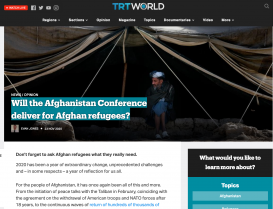
ADSP Op-Ed: Will the Afghanistan Conference deliver for Afghan refugees?
Don’t forget to ask Afghan refugees what they really need.
2020 has been a year of extraordinary change, unprecedented challenges and – in some respects – a year of reflection for us all.
For the people of Afghanistan, it has once again been all of this and more. From the initiation of peace talks with the Taliban in February, coinciding with the agreement on the withdrawal of American troops and NATO forces after 18 years, to the continuous waves of return of hundreds of thousands of migrants and refugees from neighbouring Iran, the shocks from severe seasonal droughts and flooding and the constant underlying ongoing political instability and fight for power – these are just a few of the 2020 milestones.
These challenges have been further compounded by the impacts of Covid-19, which have resulted in a huge blow to the economy, and rendered large swathes of the population food insecure. The hard-tried population of this nation has certainly not been short of pressing issues to deal with.
It is against this tumultuous backdrop, that from 23-24 November, representatives from more than 70 governments, and other international decision-makers will meet for the quadrennial Conference on Afghanistan.
Co-organised by the Government of the Islamic Republic of Afghanistan, the Government of Finland, and the United Nations, the 2020 ministerial-level conference is designed for international stakeholders to discuss key challenges and to pledge funding against the Afghan Government’s development targets.
Amongst others, key topics on the conference agenda include human rights and women’s participation; reintegrating refugees and returnees; institutional and societal methods for fighting corruption; and economic priorities and aid effectiveness.
Whilst the issue of reintegrating refugees and returnees is crucial, and something that absolutely warrants discussion – not least as it remains a key component of Afghanistan’s National Peace and Development Framework 2017-2021 – this must not be done in a vacuum and without linking to the need to support the broader range of long-term solutions for Afghan refugees. Equally as important is the need for donors and foreign governments to implement and work towards solutions for Afghans who are unwilling or unable to return.
With war and instability as the two common denominators throughout the past 40 years of Afghanistan’s history, the country has seen a mass exodus of its citizens to neighbouring countries.
Current figures estimate that there are between 1.5-2 million Afghan refugees in Iran, approximately the same number in Pakistan, and a further 170,000 in Turkey.
For these refugees, many of whom were born into displacement, little incentive remains to return to Afghanistan, a country that many of them have never set foot in. Many were born in exile, with second and third-generation refugees residing in Pakistan and Iran.
With uncertainties around access to land, limited livelihood opportunities, and ongoing security threats, refugees have largely no choice but to stay where they are for the time being.
As any casual observer of Afghanistan can see, the situation inside the country remains precarious at best. With a faltering economy, chronic food insecurity, and persistent conflict, the question remains – is Afghanistan at all ready and able to support the broad return and reintegration of refugees? In fact, in just the first half of 2020 alone, there have been more than 117,000 new displacements inside the country as a result of conflict and violence.
A further 30,000 have been internally displaced as a result of natural disasters. These newly displaced are in addition to the more than 4.1 million other internally displaced people in Afghanistan. This staggering figure illuminates Afghanistan’s precarity and instability, and the need for greater development support before a sustainable large-scale return can really be considered as a viable option.
Given the current unpredictable situation inside Afghanistan, for the vast majority of refugees in neighbouring countries, it is hard to imagine that they will be returning any time in the foreseeable future.
Whilst the peace talks between the Afghan Government and the Taliban have commenced, there is no timeline for conclusion or guarantee of their success. Even if the talks are able to achieve their intended outcomes, it will be many years before refugees are willing to forego safety and access to services such as education and healthcare in their country of asylum and risk returning to Afghanistan. As such, it is incumbent upon the international donor community to continue supporting Iran and Pakistan and the wider region to provide Afghans within their borders access to the requisite services and protection.
As these two countries have shouldered a huge responsibility for many years, it is even more essential for the international community to engage in responsibility sharing through financial support, multi-year development aid, and in cases whereby refugees are facing extreme vulnerability, resettlement.
Should refugees in host countries not receive the required support, unfortunately, some of them may make the difficult decision to undertake dangerous migration journeys, in search of this support. And they will knock on the doors of the world – in Europe and the West, or further south through countries like Thailand, Indonesia and Malaysia, with a hope of reaching Australia.
One person who made such a journey was Hayat Akbari, who at the tender age of 17 – seeing limited opportunities in Pakistan and no ability to return to his native Afghanistan – made his way to Indonesia, where he was detained and spent the next year in an Indonesian detention facility, before finally being resettled to Australia.
While Hayat’s story has a happy ending, he represents just one, out of the more than five million Afghans that have been displaced from Afghanistan throughout the past four decades. He was lucky to find safety and to create a new life. But he is the exception.
With the average period of displacement for all refugees globally hovering around 27 years, it is simply wishful thinking that Afghans will be able to voluntarily return home en masse in the near future. As such, it is essential for donors at the 2020 Afghanistan Conference to commit to both immediate humanitarian funding, and to long-term development funding inside Afghanistan. This must be simultaneously supported by longer-term support for neighbouring countries such as Iran and Pakistan. Only then will Afghan refugees have what is needed to return home in safety and with dignity.
This article was originally published in TRT World and can be viewed here.