ADSP
  • WHO WE ARE
    • History
    • Where we work
    • ADSP Strategy 2023-2025
    • Our team
    • Governing body
  • WHAT WE DO
    • Projects
    • TRAININGS AND WORKSHOPS
    • Research
    • Advocacy
    • Our Impact
    • RESOURCES
      • Global
      • Region
      • Afghanistan
      • Iran
      • Pakistan
      • Policies & Strategies
  • PUBLICATIONS
    • Research Reports
    • Statements
    • Press Releases
    • Briefing Notes
    • Submissions
    • Opinion Articles / media
    • NEWSLETTERS
  • VISUALISATIONS
    • Herat data visualisation
  • TRAININGS
  • CONTACT US

Briefing Notes

HomePublicationsBriefing Notes

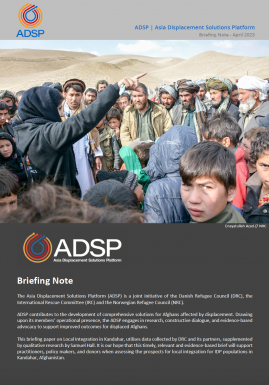
ADSP Briefing Note: Local Integration for IDPs in Kandahar? Insights from the field

April 22, 2023

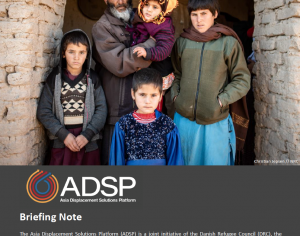
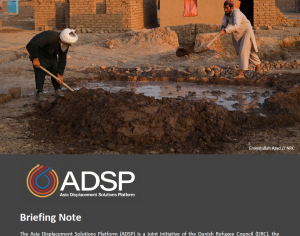
Despite the reduction in conflict after August 2021, many drivers of displacement in Afghanistan persist or have been exacerbated, leading to Afghans moving in search of protection or remaining in protracted displacement. At the same time, discussions led by the De facto Authorities (DfA) on durable solutions continue to centre on returns. This brief seeks to highlight prospects for local integration in Kandahar, one of the urban areas in Afghanistan that remains a hope for protection for many displaced. According to 2022 data from IOM’s Displacement Tracking Matrix (DTM), there were close to 250,000 internally displaced persons (IDPs) settled in Kandahar province, representing about 30% of the province’s population. Within this specific urban population are IDPs from Badghis, and other protracted IDP groups. This brief will focus on both groups and elaborate on why IDPs from Badghis are often in more precarious situations compared to other IDPs in Kandahar’s informal settlements.

Nearly all urban IDP settlements in Kandahar are informal settlements. Previously, there were 12 formal settlements but many closed due to the relocation or return of IDPs to their areas of origin. While certain IDPs returned following the fall of the Government of the Islamic Republic of Afghanistan and the end of active fighting, other IDPs were pressured to return. Most remaining informal settlements are adjacent to host communities, and located in the 7th, 8th, 9th and 12th districts of Kandahar where data collection for this brief took place.

“The IDP families that we have met, the situation of their shelter, healthcare facilities and other life’s needs are not good at all. They are mostly in survival mode and don’t have much money to pay for their other expenses except for being able to barely pay for their food. Their main concern is food nowadays. In a situation like this, it is not possible to consider other things. Their main objective is getting food to eat. Most of them are living in muddy houses and in tents. Their homes are not that good at all.” – KII 1

Local integration has long been championed as one of three possible durable solutions to displacement. However, despite a concerted push for increased recognition of, and support for local integration, it is frequently overlooked by governments and policy makers, who favour return as the preferred solution. As early as twenty years ago, experts lamented the fact that local integration is too often a forgotten solution.The Inter-Agency Standing Committee (IASC) Framework on Durable Solutions was published in 2010 to provide guidelines for local integration, alongside resettlement in a third location, as the primary pathways to achieving durable solutions.

It is in the context of severe challenges facing Afghanistan and its people that Samuel Hall, DRC and ADSP are delivering this brief on Local Integration in Kandahar, which puts forward data collected by DRC and its partners. It is our hope that this timely, relevant and evidence-based brief will be of use to practitioners, policy makers, and donors as there are currently, multiple conversations on durable solutions happening in Afghanistan, focusing on returns, as well as on the prospects for local integration. This brief addresses specifically the latter.

This brief will review existing evidence on key dimensions and criteria identified by the IASC and that are foundational to “solutions analyses” in other regions of the world as well, as seen through the work of the Regional Durable Solutions Secretariat (ReDSS) in the Horn of Africa. By documenting where information exists and where the gaps lay, it is the hope of this research brief to present areas for consolidated efforts and joint data collection to explore the viability of durable solutions in the Afghan context.

Please access the research brief here.
TagsAfghanistanIDPKandaharsolutions

Related Posts

Newsletters

ADSP Newsletter: Q4, 2025

March 11, 2026
Newsletters

ADSP Newsletter: Q3, 2025

December 12, 2025
Publications

Research Brief: Durable Solutions Analysis in Herat (July 2025)

August 28, 2025
Newsletters

ADSP Newsletter: Q2, 2025

August 18, 2025
Newsletters

ADSP Newsletter: Q1, 2025

May 29, 2025
Publications

ADSP Statement: One million Afghans returned from Pakistan at risk if unsupported

May 23, 2025
Newsletters

ADSP Newsletter: Q4, 2024

January 30, 2025
Opinion Articles / media

Expert Analysis: Water, climate, and refuge across Afghanistan and the sub-region (October 2024)

November 29, 2024
Newsletters

ADSP Newsletter: Q3, 2024

November 19, 2024
Publications

Research Brief: Durable Solutions Analysis, Jalalabad/Nangarhar (August 2024)

September 5, 2024
Newsletters

ADSP Newsletter: Q2, 2024

August 14, 2024
Publications

Research Brief: Land Allocation Schemes for the Displaced in Afghanistan (June 2024)

August 6, 2024
Newsletters

ADSP Newsletter: Q1, 2024

June 7, 2024
Briefing Notes

Briefing Note: Solutions for Afghan nationals ordered to return from Pakistan

May 13, 2024
Newsletters

ADSP Newsletter: Q4, 2023

December 27, 2023
Briefing Notes

ADSP Briefing Note – Afghan Children’s Access to Education in Iran and Pakistan

December 22, 2023
Briefing Notes

ADSP Briefing Note – Forced to migrate: Afghan women waiting for protection in Iran and Pakistan

December 22, 2023
News

ADSP-ICVA Statement – The SSAR Support Platform: ‘Showing Resilience, Seeking Solutions’

December 13, 2023
News

NGO Statement on Protection at UNHCR 74th Executive Committee Meeting

October 14, 2023
Newsletters

ADSP Newsletter: Q3, 2023

October 14, 2023
Briefing Notes

ADSP-ICVA: Explainer to the Support Platform for the Solutions Strategy for Afghan Refugees

September 10, 2023
News

ADSP Newsletter: Q2, 2023

June 24, 2023
Briefing Notes

ADSP Briefing Note: Local Integration? Insights from the field, and from a local NGO working on improving the resilience of displacement affected communities

May 17, 2023
Opinion Articles / media

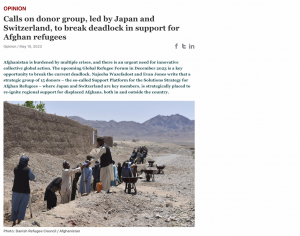
ADSP Op Ed: Calls on donor group, led by Japan and Switzerland, to break deadlock in support for Afghan refugees

May 10, 2023
Newsletters

ADSP Newsletter: Q1, 2023

March 31, 2023
Briefing Notes

ADSP Expert Commentary #2: Rethinking Durable Solutions in Peri-Urban Areas in Pakistan

March 26, 2023
Briefing Notes

ADSP Expert Commentary #1: Afghan refugees in Pakistan – Protracted displacement or protracted settlement?

March 20, 2023
TRAININGS AND WORKSHOPS

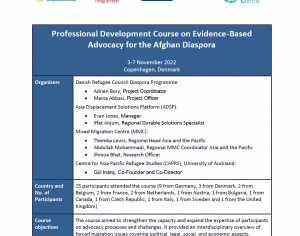
Professional Development Course on Evidence-Based Advocacy for the Afghan Diaspora

January 4, 2023
Briefing Notes

Briefing Note: IDP returns in Afghanistan: are durable solutions possible?

October 17, 2022
Newsletters

ADSP Newsletter: Q3, 2022

October 11, 2022
Newsletters

ADSP Newsletter: Q2, 2022

July 13, 2022
Opinion Articles / media

ADSP Op-Ed: Amid Afghanistan’s Emergency, Its Neighbors Need Support

June 27, 2022
News

ADSP Article: Lessons from drought response in Afghanistan

May 29, 2022
Newsletters

ADSP Newsletter: Q1, 2022

April 18, 2022
News

ADSP Submission: Intersessional Panel Discussion on the human rights of migrants in vulnerable situations

March 8, 2022
News

ADSP Newsletter: Q4, 2021

January 17, 2022
News

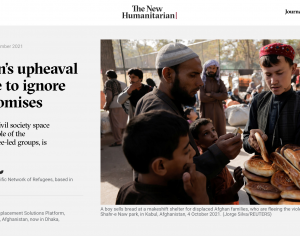
ADSP Op-Ed: Afghanistan’s upheaval is no excuse to ignore local aid promises

November 30, 2021
News

UK Foreign Affairs Committee inquiry into the future of UK policy towards Afghanistan following the international military withdrawal: Written evidence submitted by Asia Displacement Solutions Platform (AFG0014)

October 15, 2021
Newsletters

ADSP Q3 Newsletter 2021

October 1, 2021
News

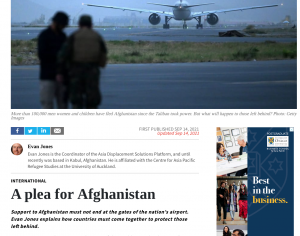
Op-Ed: A plea for Afghanistan

September 20, 2021
News

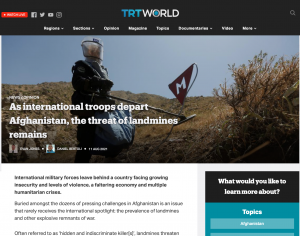
ADSP Op-Ed: As international troops depart Afghanistan, the threat of landmines remains

August 11, 2021
News

Statement: Rising instability necessitates immediate suspension of deportations to Afghanistan

July 15, 2021
News

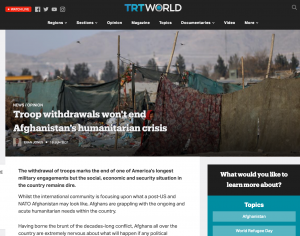
ADSP Op-Ed: Troop withdrawals won’t end Afghanistan’s humanitarian crisis

June 19, 2021
News

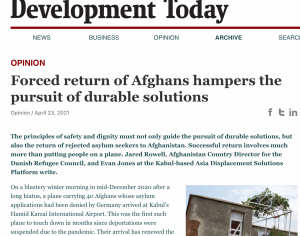
ADSP Op-Ed: Forced return of Afghans hampers the pursuit of durable solutions

April 22, 2021
Publications

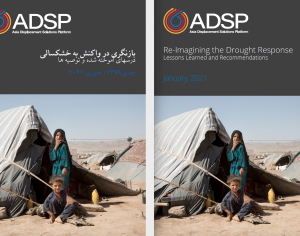
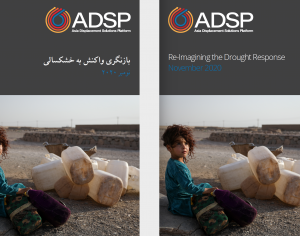
Lessons Learned & Recommendations: Re-Imagining the 2018 Afghanistan Drought Response

January 31, 2021
Publications

Re-Imagining the 2018 Afghanistan Drought Response

January 31, 2021
News

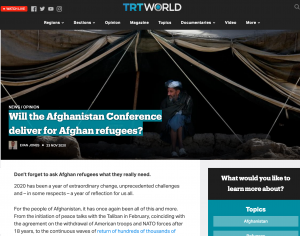
ADSP Op-Ed: Will the Afghanistan Conference deliver for Afghan refugees?

November 24, 2020

Recent Posts

  • ADSP Newsletter: Q4, 2025
  • ADSP Newsletter: Q3, 2025
  • Toward Durable Solutions: Mapping and Analysis of Displacement Data in Asia and the Pacific
  • Research Brief: Durable Solutions Analysis in Herat (July 2025)

Funded by

CONTACT US
[email protected]

© ADSP - Asia Displacement Solutions Platform 2022
  • Privacy Policy & Cookie
This website uses cookies to improve your experience. We'll assume you're ok with this, but you can opt-out if you wish.Accept Read More
Privacy & Cookies Policy

Privacy Overview

This website uses cookies to improve your experience while you navigate through the website. Out of these, the cookies that are categorized as necessary are stored on your browser as they are essential for the working of basic functionalities of the website. We also use third-party cookies that help us analyze and understand how you use this website. These cookies will be stored in your browser only with your consent. You also have the option to opt-out of these cookies. But opting out of some of these cookies may affect your browsing experience.
Necessary
Always Enabled
Necessary cookies are absolutely essential for the website to function properly. This category only includes cookies that ensures basic functionalities and security features of the website. These cookies do not store any personal information.
Non-necessary
Any cookies that may not be particularly necessary for the website to function and is used specifically to collect user personal data via analytics, ads, other embedded contents are termed as non-necessary cookies. It is mandatory to procure user consent prior to running these cookies on your website.
SAVE & ACCEPT