ADSP
  • WHO WE ARE
    • History
    • Where we work
    • ADSP Strategy 2023-2025
    • Our team
    • Governing body
  • WHAT WE DO
    • Projects
    • TRAININGS AND WORKSHOPS
    • Research
    • Advocacy
    • Our Impact
    • RESOURCES
      • Global
      • Region
      • Afghanistan
      • Iran
      • Pakistan
      • Policies & Strategies
  • PUBLICATIONS
    • Research Reports
    • Statements
    • Press Releases
    • Briefing Notes
    • Submissions
    • Opinion Articles / media
    • NEWSLETTERS
  • VISUALISATIONS
    • Herat data visualisation
  • TRAININGS
  • CONTACT US

Research Reports

HomePublicationsResearch Reports

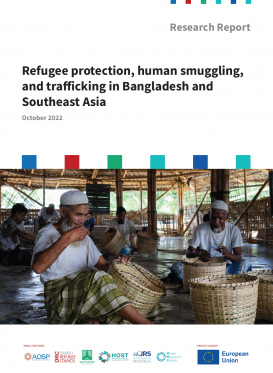
Research Report: Refugee protection, human smuggling, and trafficking in Bangladesh and Southeast Asia

December 24, 2022

The ‘Protecting Rohingya Refugees in Asia’ project brings together the Danish Refugee Council, the Asia Displacement Solutions Platform, the Mixed Migration Centre, Jesuit Refugee Service (JRS) Indonesia, HOST International, and the Geutanyoë Foundation to enhance regional protection responses in support of Rohingya refugees. Through support from the European Civil Protection and Humanitarian Aid Operations (ECHO), the project aims to identify and address the protection risks and needs of Rohingya refugees in Southeast Asia with a particular focus on Thailand, Malaysia, and Indonesia. It combines evidence-based research with programmatic and advocacy expertise to allow project partners, through their comparative advantages, to explore and advocate through new paths to support Rohingya refugees and the communities hosting them.

The first research project under the project is entitled ‘Refugee protection, human smuggling, and trafficking in Bangladesh and Southeast Asia‘. The report critically assesses the risks and needs of Rohingya refugees in Bangladesh and Southeast Asia across three thematic domains: protection, human trafficking, and human smuggling. The research draws from three national contexts: Thailand, Malaysia, and Indonesia.

The research presented 26 findings. Through close consultations between the research team and PRRiA project partners, these findings informed the development of a series of conclusions and recommendations. The primary conclusions are:

Conclusion 1: Smuggling networks enable Rohingya to leave deteriorating living conditions in Myanmar and Bangladesh and seek access to social services and economic opportunities in host countries.

Conclusion 2: An important catalyst in the adoption and architecture of national protection policies are the ASEAN Declaration on the Rights of Children in the Context of Migration, the ASEAN Convention Against Trafficking in Persons, and respective Plans of Action.

Conclusion 3: National governments have the responsibility to address protection needs by establishing clarity between smuggling and trafficking including through stronger policies with consistent messaging, implementation, and enforcement.

Conclusion 4: Civil society actors and stakeholders are limited in advocating for change in national governments due to power imbalances in partnerships, barriers to resources, and lack of political will.

Conclusion 5: The lack of national rights that recognise and safeguard refugee status is a fundamental barrier to protection in Thailand and Malaysia. Across the region, national governments must continue to address restrictions on work for refugees and access to basic services.

The full report, including research takeaways and policy recommendations can be found here.

The summary note from the Research Launch Event on 17 January 2023 can also be found here.
TagsrefugeeRohingyasmugglingSoutheast Asiatrafficking

Related Posts

Opinion Articles / media

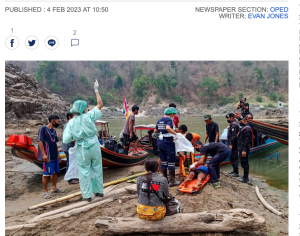
ADSP Op-Ed: Are we forgetting the Myanmar Crisis?

February 6, 2023
Press Releases

Press Release: Rescue efforts urgently needed as hundreds of Rohingya refugees continue to struggle to stave off dehydration and starvation while stranded at sea in Asia

December 23, 2022
Newsletters

ADSP Newsletter: Q3, 2022

October 11, 2022
Research Reports

ADSP Study: Barriers to accessing COVID-19 related healthcare for Afghan refugees in Khyber Pakhtunkhwa, Pakistan

May 9, 2022
News

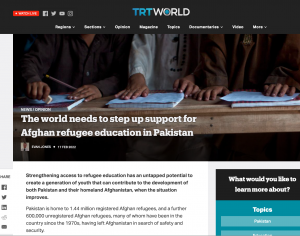
ADSP Op-Ed: The world needs to step up support for Afghan refugee education in Pakistan

February 17, 2022
News

Statement: Rising instability necessitates immediate suspension of deportations to Afghanistan

July 15, 2021

Recent Posts

  • ADSP Newsletter: Q4, 2025
  • ADSP Newsletter: Q3, 2025
  • Toward Durable Solutions: Mapping and Analysis of Displacement Data in Asia and the Pacific
  • Research Brief: Durable Solutions Analysis in Herat (July 2025)

Funded by

CONTACT US
[email protected]

© ADSP - Asia Displacement Solutions Platform 2022
  • Privacy Policy & Cookie
This website uses cookies to improve your experience. We'll assume you're ok with this, but you can opt-out if you wish.Accept Read More
Privacy & Cookies Policy

Privacy Overview

This website uses cookies to improve your experience while you navigate through the website. Out of these, the cookies that are categorized as necessary are stored on your browser as they are essential for the working of basic functionalities of the website. We also use third-party cookies that help us analyze and understand how you use this website. These cookies will be stored in your browser only with your consent. You also have the option to opt-out of these cookies. But opting out of some of these cookies may affect your browsing experience.
Necessary
Always Enabled
Necessary cookies are absolutely essential for the website to function properly. This category only includes cookies that ensures basic functionalities and security features of the website. These cookies do not store any personal information.
Non-necessary
Any cookies that may not be particularly necessary for the website to function and is used specifically to collect user personal data via analytics, ads, other embedded contents are termed as non-necessary cookies. It is mandatory to procure user consent prior to running these cookies on your website.
SAVE & ACCEPT