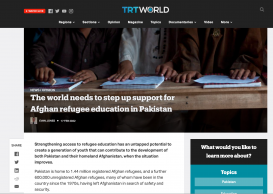
ADSP Op-Ed: The world needs to step up support for Afghan refugee education in Pakistan
Strengthening access to refugee education has an untapped potential to create a generation of youth that can contribute to the development of both Pakistan and their homeland Afghanistan, when the situation improves.
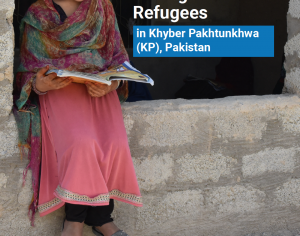
Pakistan is home to 1.44 million registered Afghan refugees, and a further 600,000 unregistered Afghan refugees, many of whom have been in the country since the 1970s, having left Afghanistan in search of safety and security.
The UN estimates that almost 80 percent of school-age Afghan refugees are currently not enrolled in or accessing formal primary education. Given the Taliban takeover and recent developments in Afghanistan, education for Afghan youth in host countries like Pakistan is more important than ever, especially for young girls and others with special needs.
Whilst Pakistan does not have any formal legal framework protecting refugees, there has been a general historical willingness by Pakistani authorities to allow Afghans to remain in the country until conditions at home improve.
For registered Afghan refugees – known officially as Proof of Registration (PoR) cardholders – this status has importantly extended to them being able to access basic services, including primary education. As is the case anywhere in the world, education is a core human right that provides the foundation for individuals to live sustainable and fulfilling lives.
Access to primary-level education for refugees in Pakistan is actually enshrined in law and policy. In practice, however, the ability for Afghan youth to access schooling is far from straightforward.
Due to a multitude of barriers — which poor Pakistani children also face but is compounded for refugees — such as tuition costs, transportation expenses, the distance of schools from refugee housing, and outdated teaching practises amongst others, large numbers of Afghan refugee children remain without an education.
Challenges to education access and quality were compounded by the Covid-19 pandemic. During March 2020 to February 2021, schools in Pakistan were closed for 137 days, per government directives. With limited access to online learning platforms, many refugees not only missed out on significant amounts of education, but also dropped out completely.
Access to education for girls lagging behind
Within the broader population of Afghan refugee children in Pakistan – particularly in Khyber Pakhtunkhwa province – girls face additional obstacles in obtaining an education. As of June 2021, it was estimated that out of the current 31,266 students studying at schools in the so-called ‘refugee villages’, only 35 percent were girls.
In many locations, girls’ schools do not exist, or they are located too far from refugee housing, which leaves co-educational schools as the only available option – one that most conservative households choose not to avail.
With the commencement of the Covid-19 pandemic, many children were also forced to forgo education to support their families in domestic labour. Loss of livelihoods within families also resulted in negative coping mechanisms such as an uptick in early marriages, particularly amongst girls.
Education as a cornerstone for long-term solutions
For refugees, access to education plays a crucial role in generating resilience, strengthening community support networks, providing the skills needed to access future livelihoods, and to live independent and rewarding lives. Schools also act as spaces where educators can identify risks faced by children – whether that be healthcare needs, potential abuse, learning difficulties, or other support services.
In a child’s formative years, classrooms have the potential to be transformational. If quality and inclusive education is available, and children and their parents are committed to the education on offer, children can develop the foundations needed for them to escape poverty and lead independent and resilient lives. Education and training also provide the bedrock needed for all individuals – refugees or otherwise – to seek and secure gainful employment when they reach adulthood.
In the case of Pakistan, strengthening access to refugee education has an untapped potential to create a generation of youth that can contribute to the development of both Pakistan and their homeland Afghanistan when the situation improves.
What should be done to change the status quo?
To address the cultural, structural, and policy-level gaps related to education for Afghan refugee children in Pakistan, civil society has identified numerous tangible steps that can be taken by the Government of Pakistan, the UN refugee agency, and donors.
Remedies include the construction of additional girls’ schools, eliminating physical infrastructure barriers for disabled children and girls, reducing the distances that refugees must travel to school, investing in teacher training, and, developing reintegration programmes for students that may have been compelled to drop out of school. These steps won’t solve all existing challenges, but they will contribute to greater future enrollment and student retention.
Importantly, it is also incumbent upon all actors supporting education for Afghan refugee children to ensure that Afghan refugees themselves are front and centre in decision making. This can be done through inclusion of Afghan refugees in critical decision-making, improving the effectiveness of Parent-Teacher Committees, as well as ongoing engagement with parents. Only with the direct inputs of affected persons themselves, can parents make informed decisions of their child’s specific needs.
Having generously hosted Afghan refugees for decades, Pakistan cannot and should not be expected to remedy the current situation alone. Only with the support of the international community, donors, and civil society will Afghan refugee children be able to fully realise their right to access high-quality education.
With technical support, capacity building of government staff, investment in physical infrastructure, and a long-term commitment by donors and international actors, can the government deliver much-needed education reforms for refugees.
The original article can be found in TRT World.