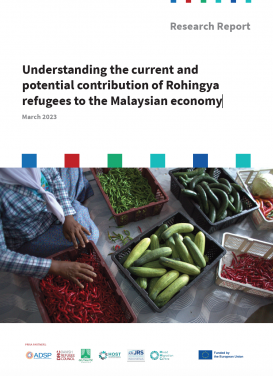
Research Report: Understanding the current and potential contribution of Rohingya refugees to the Malaysian economy
As of November 2022, Malaysia hosted 182,990 refugees and asylum seekers, 106,120 of whom were Rohingya. However, Malaysia is not a signatory to the 1951 Convention Relating to the Status of Refugees or its 1967 Protocol and does not have a legislative framework for refugee protection. Notwithstanding barriers to legal employment, a UNHCR study found that 60% of refugee adults in Malaysia were employed. The large informal employment sector in Malaysia, which constituted 23% of total employment in 2021, provides livelihood options for refugees. However, informal employment makes refugees susceptible to high risks of exploitation, including verbal and physical abuse by employers, partial or non-payment of wages, and lack of protection in high-risk work environments.
Through collaboration between Rohingya-led community-based organisations (CBOs), the Mixed Migration Centre (MMC) and partners of the Protecting Rohingya Refugees in Asia (PRRiA) project, participatory research was conducted to gain a better understanding of Rohingya refugees’ existing livelihood strategies and challenges in Malaysia. The research focuses on employment profiles and the challenges Rohingya refugees face in accessing livelihoods and decent work, as well as their potential to contribute to the Malaysian economy, should their legal status and access to the labour market be formalised.
The study presents evidence collected by the Rohingya community to inform policymaking on issues related to Rohingya refugees’ work rights in Malaysia.
Key Findings
Skills
- Knowledge of Malay language was most regularly reported (22%) as a useful skill in the job market, followed by construction skills (21%) and grass cutting skills (13%).
- The top five skills respondents reported interest in learning for better income-generation were: electricity and wiring (16%), sewing (14%), English language (12%), air-conditioner servicing (11%), and business or accounting (9%).
Livelihoods
3. Male respondents reported benefitting from relatively better livelihoods in Malaysia as their unemployment rate dropped from 30% prior to coming to Malaysia to 2% in Malaysia; the unemployment rate for female respondents decreased slightly from 26% to 20%.
4. In Malaysia, the most common economic sectors respondents were working in were services (47%), construction (23%), and self-employment (10%). Before coming to Malaysia, most who were working had been engaged in agriculture and fishing (23%), self-employment (11%), and services (7%).
Access to information
5. 39% of respondents approached family or friends and 31% went to community organisations for information about job availability and job vacancies in Malaysia. Other popular avenues were going door-to-door (31%) and approaching local Malaysians (29%).
Risk and challenges
6. 87% of the 158 respondents who had worked during the last five years in Malaysia reported experiencing protection incidents at their workplace. The most common exploitation experienced at the hand of employers, and relate to pay.
7. Arrest or detention (66%), bribery or extortion (61%), and confiscation of UNHCR card (40%) or other IDs were the three most common protection incidents perpetrated by the authorities.
Assistance
8. Although a majority of the respondents were employed, many continue to live in precarity. 95% indicated the need for livelihood assistance, especially financial assistance, but most (87%) reported not receiving any in the last 12 months in Malaysia.
Key Policy Recommendations
For humanitarian and aid organisations:
i. Formulate livelihoods programming that actively mainstreams gender, builds on the community’s strengths, integrates community needs, and promotes sustainability and resilience.
ii. Facilitate access to information about livelihood opportunities and protection assistance.
iii. Advocate for the legal rights to work.
For policymakers in Malaysia:
i. Formalise refugees’ rights to work through engagement with refugee community, private sectors, Malaysian citizens, civil society organisations and international organisations.
ii. Promote labour protection and fair compensation for informal employment.
The full research report can be found in English here and in Malay here.