ADSP Op-Ed: Displaced from Myanmar: Can’t Go Back and Can’t Go Forward
Despite the sizeable numbers of refugees from Myanmar within Asia, the overall protection environment remains flimsy.
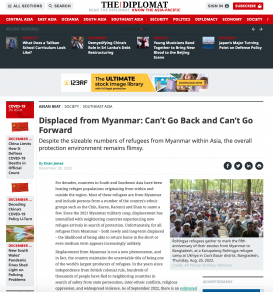
For decades, countries in South and Southeast Asia have been hosting refugee populations originating from within and outside the region. Most of these refugees are from Myanmar and include persons from a number of the country’s ethnic groups such as the Chin, Karen, Karenni and Shan to name a few. Since the 2021 Myanmar military coup, displacement has intensified with neighboring countries experiencing new refugee arrivals in search of protection. Unfortunately, for all refugees from Myanmar – both newly and long-term displaced – the likelihood of being able to return home in the short or even medium term appears increasingly unlikely.
Displacement from Myanmar is not a new phenomenon, and in fact, the country maintains the unenviable title of being one of the world’s largest producers of refugees. In the years since independence from British colonial rule, hundreds of thousands of people have fled to neighboring countries in search of safety from state persecution, inter-ethnic conflicts, religious oppression, and widespread violence. As of September 2022, there is an estimated 1,055,000 refugees from Myanmar scattered across the region – 200,000 of them non-Rohingya from Myanmar.
Despite the sizeable numbers of refugees from Myanmar within Asia, the overall protection environment remains flimsy. Across India, Malaysia, and Thailand, international treaty ratification related to refugees is absent, domestic legal protection frameworks are weak, and access to healthcare, education, livelihoods, and other basic services is unavailable or ad hoc at best. Refugees are stuck in positions where they cannot return home, most cannot access resettlement countries, and cannot thrive where they are. In Malaysia, the threat of arrest, detention and deportation for Myanmar nationals looms large.
For one member of the Chin ethnic group currently displaced in Manipur, India, displacement is “challenging and without an end in sight.” He said “the local people have been warm, and understand our plight, and for this we are thankful. But that hasn’t meant things are easy.” He acknowledges the challenges for refugees in India such as an inability to access livelihoods and other basic services, but at the same time, he describes the return to Myanmar as “simply not an option that I can consider for me and my family right now. Our only hope is for the kindness of the Indian people to support us at this time of need.”
Local Responses to Refugee Protection
In India and Malaysia, refugees receive little to no assistance from host governments and for the most part must fend for themselves. Most often, they find some form of support through informal community networks, local NGOs, or through the diaspora. In northeast India, refugees – primarily from the Chin ethnic group – have found support through friends or family that have been resettled abroad, or from local community organisations. Similarly, in Malaysia, refugees receive help through community groups, local NGOs, and through informal employment.
Whilst this informal and ad hoc support helps many refugees to “get by,” it leaves significant protection concerns and simultaneously precludes them from becoming truly self-reliant. As the primary means of assistance – and in the absence of other opportunities – these local support networks need strengthening and resourcing. Only by donors supporting NGOs and local groups that have the trust and understanding of refugee communities, can those persons most in need of support be reached.
The Crucial Role of Donors and Host Countries
For some nations like Canada, the United States and Australia, the past year has brought about renewed commitments to maintain support for refugees and displaced communities. The United States for example has begun to build back its resettlement program and its intake from Asia, whilst Australia has created additional humanitarian spots for persons from Afghanistan and simplified its community sponsorship arrangements. These positive movements should be applauded, supported, and where possible expanded.
However, such efforts from a select few donor states are not enough, with regional governments needed to also step forward in their important role as host countries with refugees inside their borders. Governments in the region, including Malaysia and India, have hosted refugees for many years. Over this time, they have provided safety for hundreds of thousands of refugees and have ensured that were not sent back to harm’s way. Whilst this is laudable, due to their lack of formal accession to relevant international instruments – and their comparatively limited resourcing – they have not fully taken on board the responsibility for refugees in their borders.
As countries within the region continue to grow economically, the time has come for increased responsibility sharing – even in the absence of formal legal frameworks at this stage. Whether that be through opening spaces for livelihood opportunities, increased access to education, supporting access by UNHCR to affected populations or other initiatives, there are numerous ways that refugees together with their host communities can be supported.
The NGO community, academia, civil society, and other stakeholders remain allies to host governments in this endeavour. By working together as a collective and coordinated group of actors for the betterment of people’s lives, we all have the power to institute positive change to support refugees from Myanmar and other vulnerable groups.
This article was originally published in The Diplomat, and can be accessed here.